
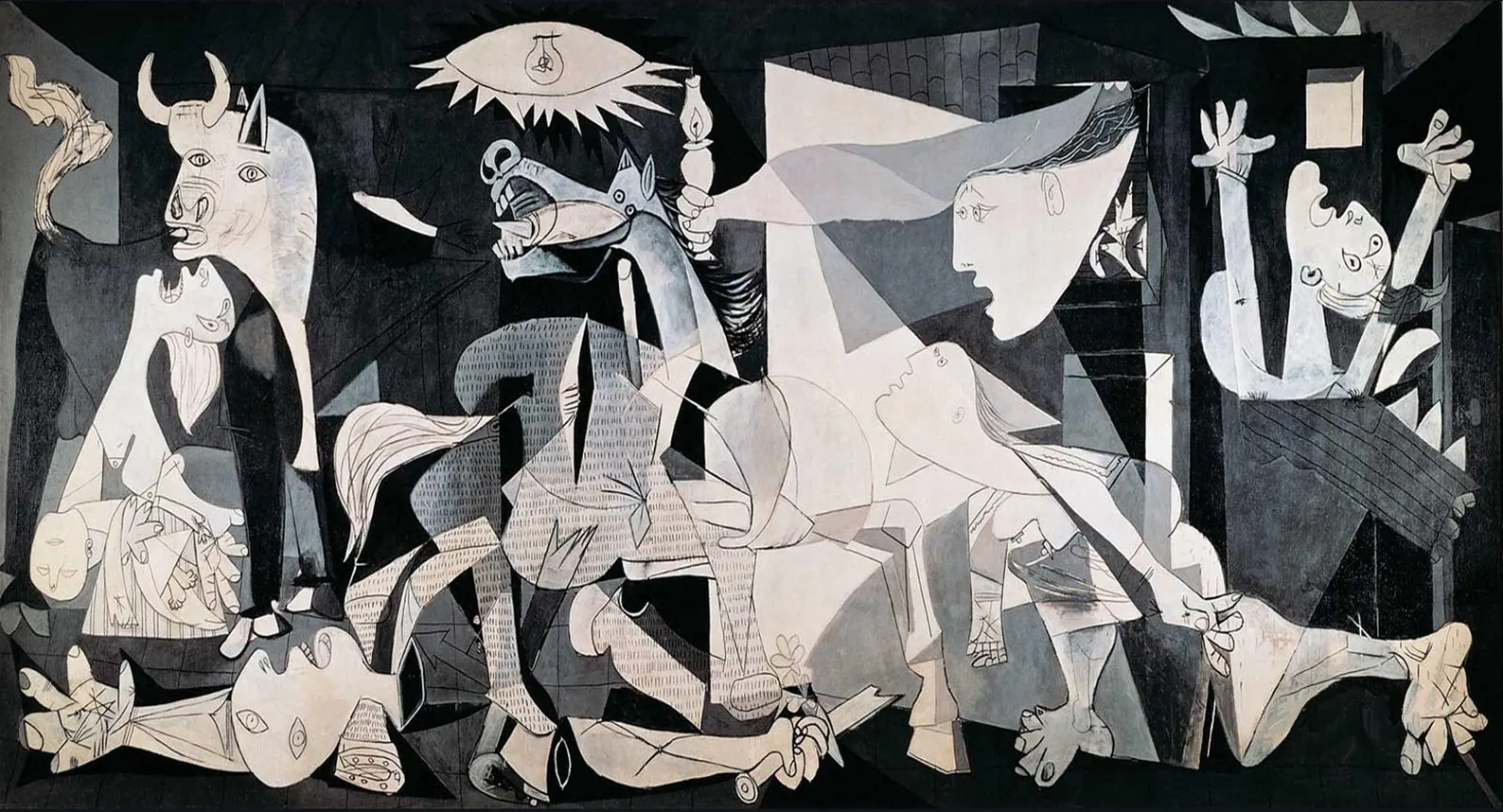
When considering Picasso’s painting Guernica, we have to consider the facts we know:
– he was commissioned to paint it by the Second Spanish Republic for the 1937 Paris world fair.
– when asked about the meaning of the painting – he said “In the panel on which I am working, which I call Guernica, I clearly express my abhorrence of the military caste which has sunk Spain into an ocean of pain and death.” and “This bull is a bull and this horse is a horse… If you give a meaning to certain things in my paintings it may be very true, but it is not my idea to give this meaning. What ideas and conclusions you have got I obtained too, but instinctively, unconsciously. I make the painting for the painting. I paint the objects for what they are.”
– this was done during the rise of Franco in 1937 (from France) after the 1872 Carlist War, after WWI, during the Civil war – prior to WWII.
– Picasso was struggling to figure out what to paint – but this massive bombing of the Basque town Geurnica occurred right in the middle of his painting process
From this we can synthesise about the meaning of the skull.
On a simplistic level you can say that Picasso was saying “Art means whatever you want it to mean.” or “I won’t insult your intelligence by spelling it out.” Also that the bull represents brutality and darkness, and the horse the suffering humanity
I think we need to consider more of the context. Literary evidence (The Shadow of the Wind – Carolos Ruiz Zafon) suggests Spain was war-weary even by this point. Also Picasso was an artist without overwhelmingly generous benefactors like Gaudi. He had spent his early life (Blue period) living in down and out places.
I paint in my mind Picasso’s view of the Republican government a bit like we view the Clintons today. Symbolising a world of growth, jobs, and international trade, their own elitism and corruption all part of the package.
So he signs up for the job with a bit of a shrug and takes the retainer cheque – perhaps thinking of school fees for his kids.
Through the creative process he gets a spark that will work for his patrons and delivers the artwork – on-brand for the social and artistic mood of the day. Knowing he must make his moneyed-up patrons feel sophisticated and intelligent, he paints in just enough of a puzzle for them to jump to the conclusion that makes them feel right about the world.
In truth we know that Picasso experienced impoverished districts and wanted to talk about the issues of the poor. He actually felt a connection to the people at the bottom, to want to speak to their issues, the problem being they would never pay him for his work.
For the ordinary people, the ideology of one side of politics matters little, and less so for a nation weary of war. Picasso understood this.
So when a suited-up interviewer and a smiling photographer representing the press of the elite seek out Picasso and says, “Oh look how clever – the bull means Spain, and the hidden skull means death, and the painting is about how autocratic regimes kill people, right? So the Dictator is Evil, right? [You’re one of us? wink wink?]” Picasso stares into space for a moment, sighs, and says “A bull is a bull.”